Roe – Learn
-
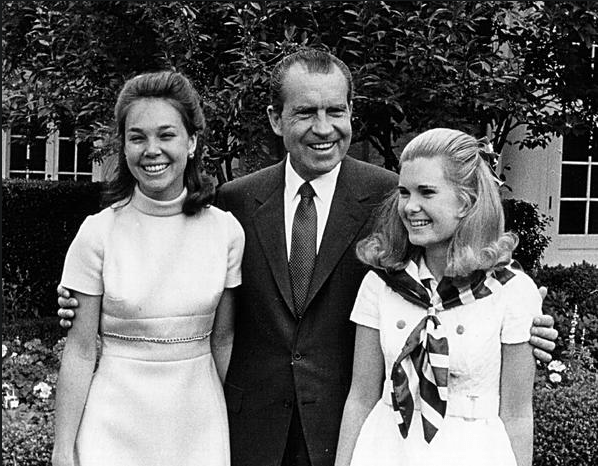

“I know there are times when abortions are necessary. I know that… I just say that matter-of-factly, there are times. Abortions encourage permissiveness. A girl gets knocked up, she doesn’t have to worry about the pill anymore, she goes down to the doctor, wants to get an abortion for five dollars or whatever.”
– President Richard NixonPhoto: President Richard Nixon laughs with his daughters, Julie, left, and Tricia, right, June 13, 1969 at the White House.
Credit: National Archives In 1971, Congress passed the Child Development Act, which would have established a federally subsidized network of community child care centers, with the initial support of President Nixon. Nixon ultimately vetoed the bill after a coalition of Protestants and John Birchers mobilized against it, calling it an attack on the family.
In the decade after 2010, care for infant in a day care was more expensive than tuition and fees in a public university in half the states in the US, yet day care workers were still severely underpaid – on average, they would have to pay more than 80% of their wages to put their own child in a day care center.
Photo: Women demonstrate for accessible child care at the First Women’s March down Fifth Avenue on August 26, 1970.
Credit: Freda Leinwand. Schlesinger Library. Radcliffe Institute. Harvard University.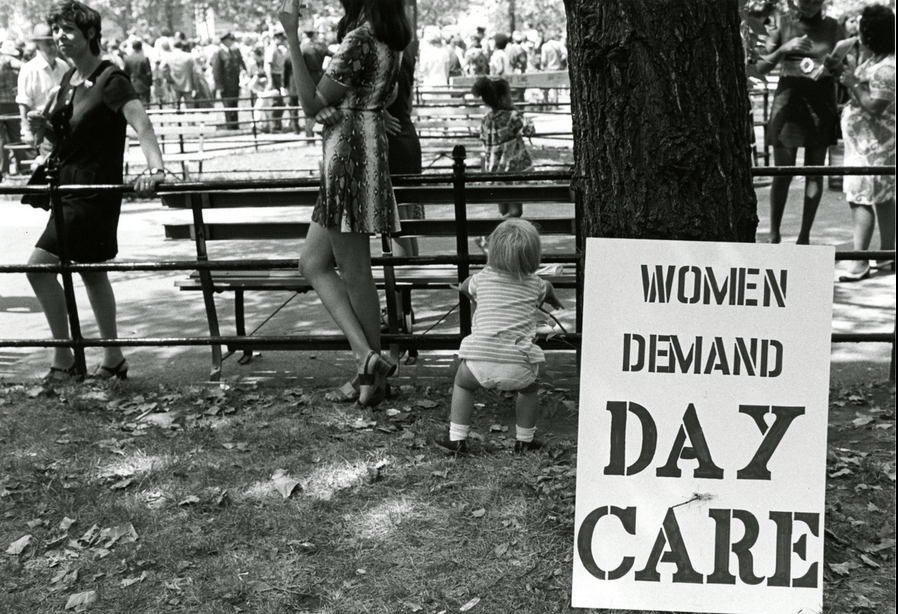
-
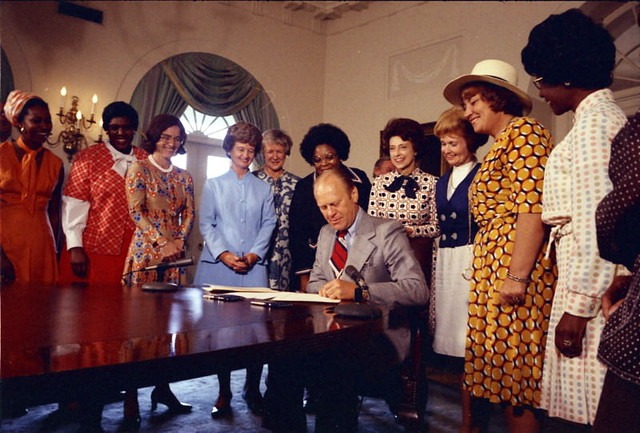
“I support the Republican platform which calls for a constitutional amendment that would outlaw abortions. I favor the particular constitutional amendment that would turn over to the States the individual right of the voters in those States the chance to make a decision by public.”
– President Gerald FordPhoto: President Ford signs an executive order establishing the National Commission for the Observance of International Women’s Year, 1975. Photo credit: David Hume Kennerly Relf v. Weinberger: Mary Alice and Minnie Relf, poor African American sisters from Alabama, were sterilized at the ages of 14 and 12. Their mother, who was illiterate, had signed an “X” on a piece of paper she believed gave permission for her daughters, who were both mentally disabled, to receive birth control shots. In 1974, the Southern Poverty Law Center filed a lawsuit on behalf of the Relf sisters, revealing that 100,000 to 150,000 poor people were being sterilized each year under federally-funded programs. The case was dismissed in 1977.
Eugenics Compensation Act: In December 2015, the US Senate voted unanimously to help surviving victims of forced sterilization. North Carolina has paid $35,000 to 220 survivors of its eugenics program. Virginia agreed to give survivors $25,000 each.
Photo: “Stop Forced Sterilization” poster by Rachael Romero, San Francisco Poster Brigade, 1977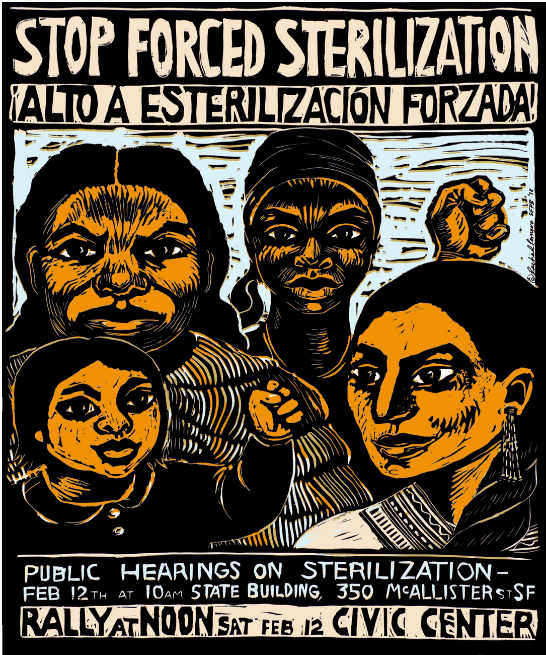
-
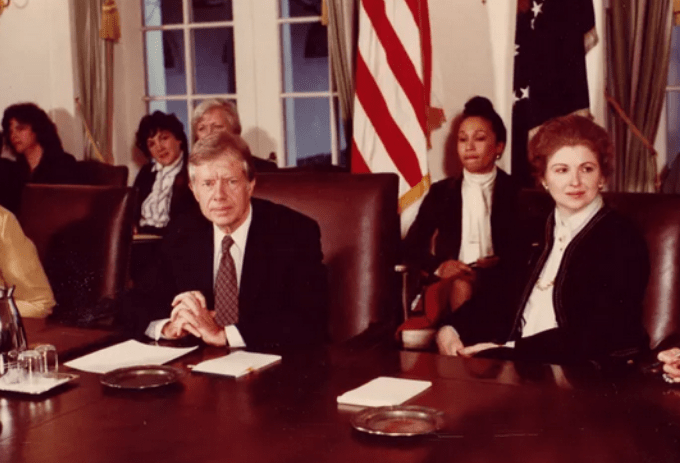
“In 1977, I defended my lack of support for federal funds to be used for abortions among poor mothers […and] responded to a question on this issue by saying, ‘Life is often unfair.’”
– President Carter
Photo: Sarah Weddington with president Jimmy Carter. She served as his advisor from 1978 to 1981 Originally signed in 1976, the HYDE AMENDMENT is a legislative provision barring the use of federal funds to pay for abortion except to save the life of the woman, or if the pregnancy arises from incest or rape.
Since 1976, anti-choice politicians have added abortion coverage and funding bans to appropriations language that restricts: Medicaid, Medicare, and Children’s Health Insurance Program enrollees; federal employees and their dependents; Peace Corps volunteers; Native Americans; women in federal prisons and detention centers, including those detained for immigration purposes; women who receive health care from community health centers; survivors of human trafficking; and low-income women in the District of Columbia. In 1980, Supreme Court Justice Thurgood Marshall stated that, “The Hyde Amendment is designed to deprive poor and minority women of the constitutional right to choose abortion.”
Photograph of Women Holding Banner, “If Men Got Pregnant Abortion Would be Sacred” at the National Women’s Conference. Source: US National Archives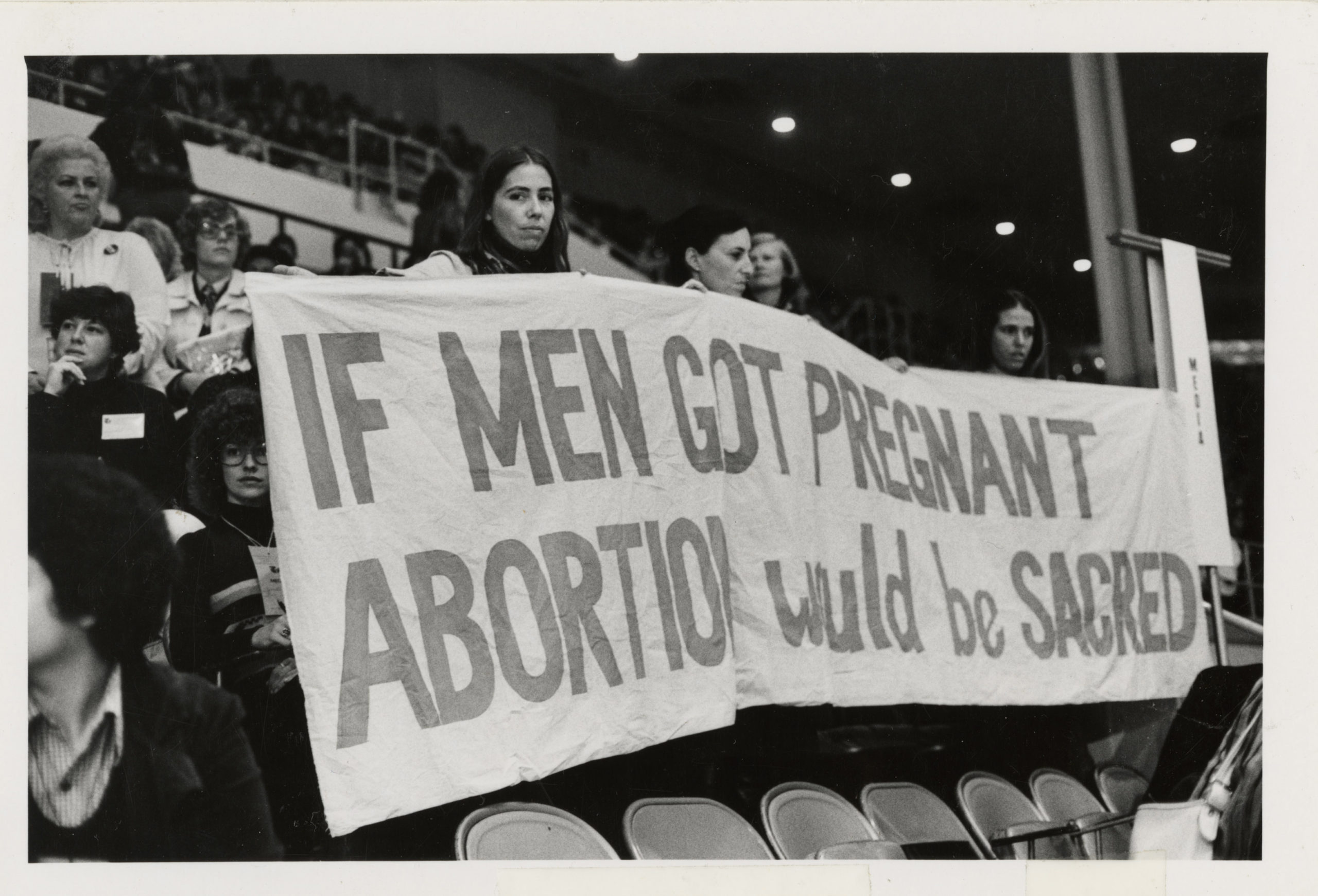
-

“I’ve noticed that everyone who is for abortion has already been born.”
– President Ronald ReaganRonald and Nancy Reagan wave during the Inaugural Parade, Jan. 20, 1981. Ronald Reagan Presidential Library. The outbreak of AIDS in the 1980s gave proponents of public school sex education a powerful argument. But the Reagan Administration favored abstinence-only education that advocated no sex at all until marriage and dismissed homosexuality as amoral. Conservative spokesperson Phyllis Schlafly went so far as to state that: “sex education classes are like in-home sales parties for abortions”.
Photo: Artist David Wojnarowicz in 1988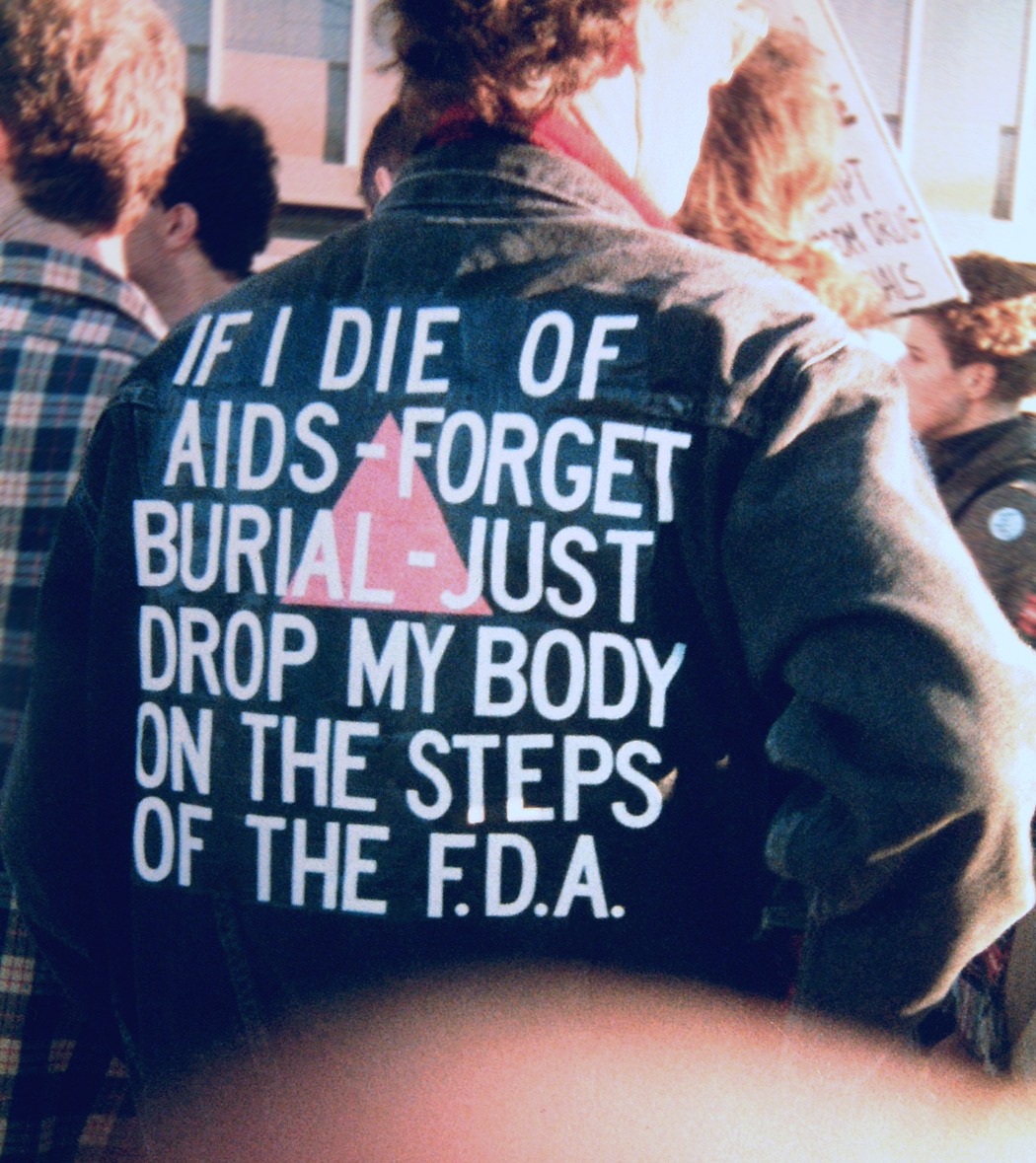
-
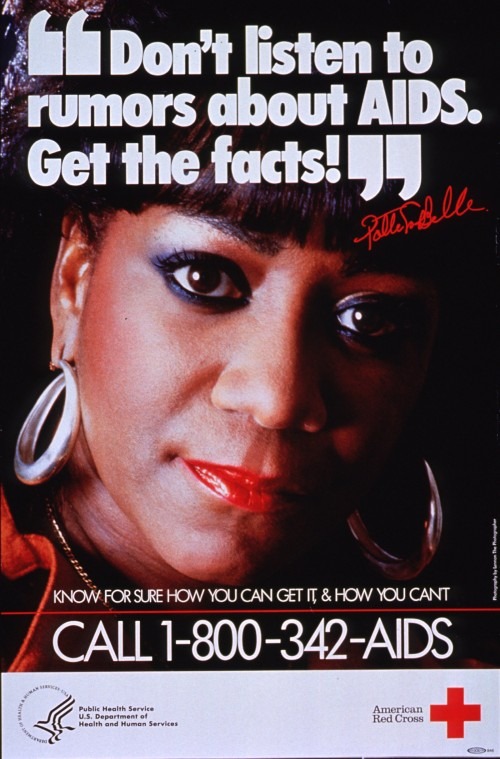
While it’s true that abstinence is the only 100% way to prevent both unwanted pregnancy and sexually-transmitted diseases such as HIV, in practice, abstinence-only programs have not been shown to have any impact on young people’s behavior. In addition, abstinence programs often withhold critical, possibly life-saving information about STIs and HIV thereby putting young people’s health and future at risk.
Photo: Patti LaBelle in a 1980s advertisement for the national AIDS helpline “I strongly support family planning and have always favored disseminating information on birth control. I do not favor advocating abortion in any way, shape, or form.”
– President George H. W. Bush SeniorPhoto: Chief Justice William Rehnquist administering the oath of office to President George H. W. Bush during Inaugural ceremonies at the United States Capitol. January 20, 1989. Library of Congress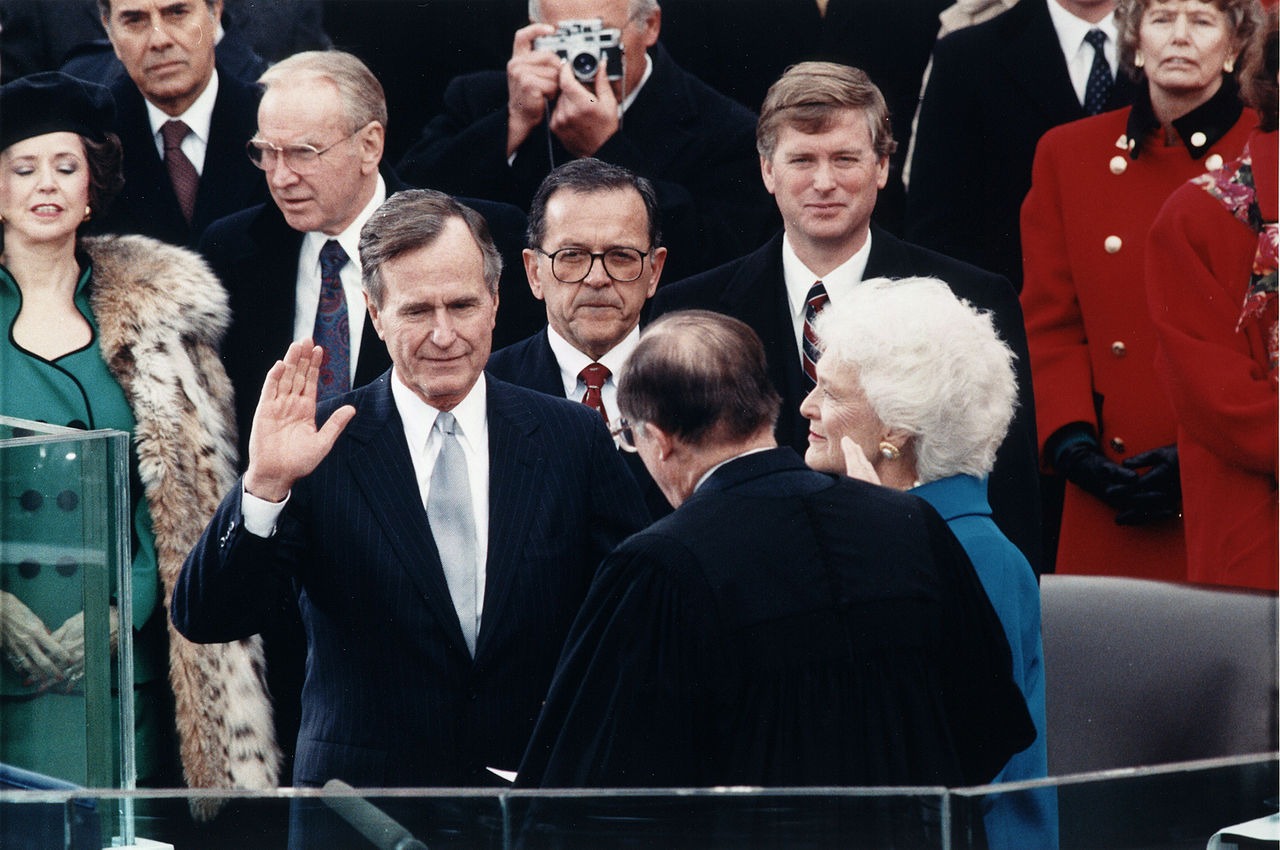
-
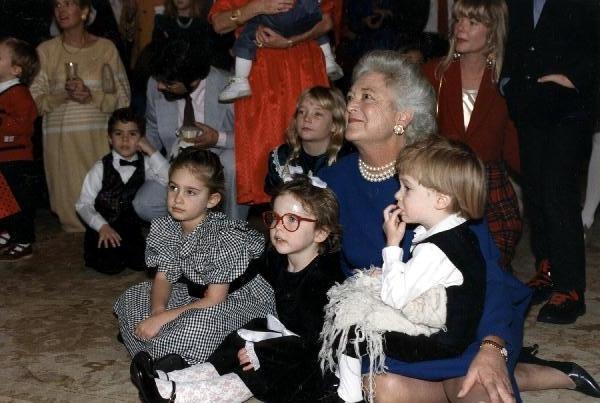
Barbara Bush had different views on abortion than did George H.W. Bush. In her private diaries, she wrote, “‘Having decided that the first breath is when the soul enters the body, I believe in federally funded abortion. Why should the rich be allowed to afford abortions and the poor not?’ She said she could support limits on the timing of abortions—’12 weeks, the law says’—but she wrote it was ‘not a Presidential issue,’ underlining not twice. ‘Abortion is personal, between mother, father and Dr.’”
Photo: First Lady Barbara Bush sits on the floor with her grandchildren and watches Frosty the Snowman, Residence of the White House, December 17, 1989. George Bush Presidential Library and Museum Casey v. Planned Parenthood (1992) Challenged the five provisions of the Pennsylvania Abortion Control Act of 1982: Informed Consent, Spousal Notice, Parental Consent (in the case of minors), “Medical Emergency”, and Reporting Requirements. The case provided the first opportunity to overturn Roe. The Court ruled in favor of Planned Parenthood, reaffirming the central holding of Roe by replacing the trimester framework with the viability framework and replacing the strict scrutiny analysis with the “undue burden” standard. It also ruled the spousal notification provision unconstitutional.
“‘I am pleased with the Supreme Court’s decision,’ President George [HW] Bush said in a written statement released after the Court issued its ruling in Planned Parenthood of Southeastern Pennsylvania v. Casey on June 29. That was a little surprising, considering that a majority on the Court had just voted to uphold Roe v. Wade, the 1973 decision giving constitutional status to abortion rights. The same day, Bill Clinton called a press conference to assert that ‘the constitutional right to choose is hanging by a thread.’”
Credit: NARAL Pro-Choice America Timeline, 1992, on the ruling of Casey v. Planned Parenthood.
-

“It’s hard to apply the criminal law to acts that a substantial portion of the citizenry doesn’t believe should be labeled crimes, (as with Prohibition). I thought then [in the 1973 Roe v. Wade decision] and still believe that the Court reached the right conclusion.”
– President Bill ClintonPhoto: Bill Clinton on the Campaign trail, shaking hands with Kate Michelman, former leader of NARAL Pro Choice America June 30, 1992 By the early 1990’s, clinic protests and blockades were on the rise. Violence against abortion providers was also escalating across the country, culminating in the murder of Dr. Gunn in March of 1993 outside a Pensacola, FL clinic (who had been the subject of wanted-style posters distributed by Operation Rescue) and the attempted murder of Dr. Tiller in August of 1993 outside his Wichita, KS clinic. The next summer, Dr. John Britton and James Barrett, a clinic escort, were killed outside another clinic in Pensacola, and in December 1994, two receptionists, Shannon Lowney and Lee Ann Nichols, were killed and five people injured at two clinic attacks in Brookline, Massachusetts.
In 1994 Congress passed the Freedom of Access to Clinic Entrance (FACE) Act which forbids threats, force or physical obstruction aimed at preventing someone from obtaining reproductive health services. Clinic protests remain common.
Photo: Operation Rescue founder Randall Terry kneels in prayer outside the Woman’s Health Care Services abortion clinic in Wichita, Kansas, with over 1,000 other protesters in 1991. Photo Credit: Steve Rasmussen
-
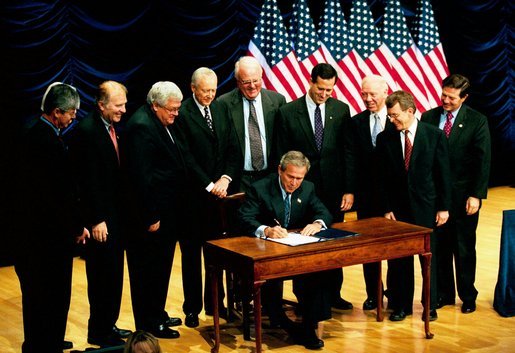
“In the debate about the rights of the unborn, we are asked to broaden the circle of our moral concern. We’re asked to live out our calling as Americans. We’re asked to honor our own standards, announced on the day of our founding in the Declaration of Independence. We’re asked by our convictions and tradition and compassion to build a culture of life, and make this a more just and welcoming society.”
– President George W. BushPhoto: President George W. Bush signing the Partial Birth Abortion Ban, 2003 On January 22, 2001, on his first business day in office (and the 28th anniversary of Roe v. Wade, the landmark U.S. Supreme Court decision establishing a woman’s right to an abortion), President George W. Bush re-imposed the Global Gag Rule on the U.S. Agency for International Development (USAID) population program. This policy restricts foreign non-governmental organizations (NGOs) that receive USAID family planning funds from using their own, non-U.S. funds to provide legal abortion services, lobby their own governments for abortion law reform, or even provide accurate medical counseling or referrals regarding abortion. The 1973 Helms Amendment is a legislative provision that already restricts U.S. funds from being used for these activities.
Photo: Mrs. Laura Bush poses in front of Mary Cassatt’s painting, “Young Mother and Two Children,” March 2, 2001, for an official portrait in the White House. George W. Bush Presidential Library and Museum.
-
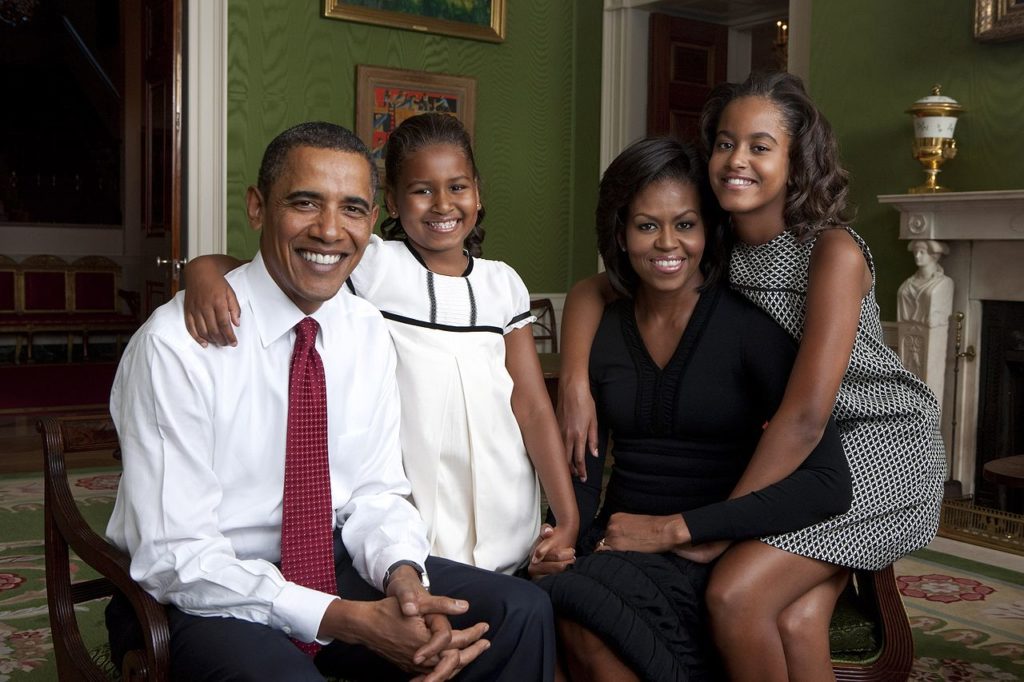
“As long as we’ve got to fight to make sure women have access to quality, affordable health care, and as long as we’ve got to fight to protect a woman’s right to make her own choices about her own health, I want you to know that you’ve also got a President who’s going to be right there with you fighting every step of the way.”
– President Barack ObamaPhoto: Obama Family Portrait in the Green Room, September 209. Photo Credit: Annie Leibovitz. Official White House Photograph. Obergefell v. Hodges: on June 26, 2015, the Supreme Court struck down all state bans on same-sex marriage, legalizing it in all fifty states and requiring states to honor out-of-state same-sex marriage licenses. For the courts, one of the most important arguments for same-sex marriage has been the protection of gay and lesbian paternal rights.
In Massachusetts today, as WAM’s General Manager Dori Parkman attested last year, Gay and Lesbian parents have to adopt their own children in order to gain the same legal protection as heterosexual parents.
Photo: Participants at Garden State Equality May 2011 protest.
-
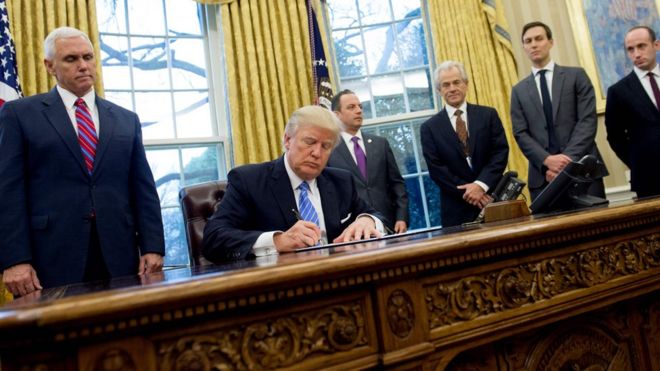
“Right now, a number of state laws allow a baby to be born from his or her mother’s womb in the ninth month. It is wrong. It has to change.”
– President Donald TrumpPhoto: President Donald Trump signing an executive order reinstating the global gag rule banning international NGOs with U.S. funding from providing abortions or offering information. July 2017 The phrase “Me Too” in connection to sexual assault survival was initiated on MySpace by Tarana Burke in 2006. It gained traction as a hashtag following the exposure of widespread sexual-abuse allegations against Harvey Weinstein in early October 2017, and in connection to the publication of President Trump boasting about “grabbing women by the pussy”. On October 15, 2017, American actress Alyssa Milano posted on Twitter: “If all the women who have been sexually harassed or assaulted wrote ‘Me too’ as a status, we might give people a sense of the magnitude of the problem.” Millions of people responded. A 2017 poll by ABC News and The Washington Post also found that 54% of American women report receiving “unwanted and inappropriate” sexual advances, with 95% saying that such behavior usually goes unpunished.
Photo: The Women’s March January 21, 2017 – the day after Donald Trump’s inauguration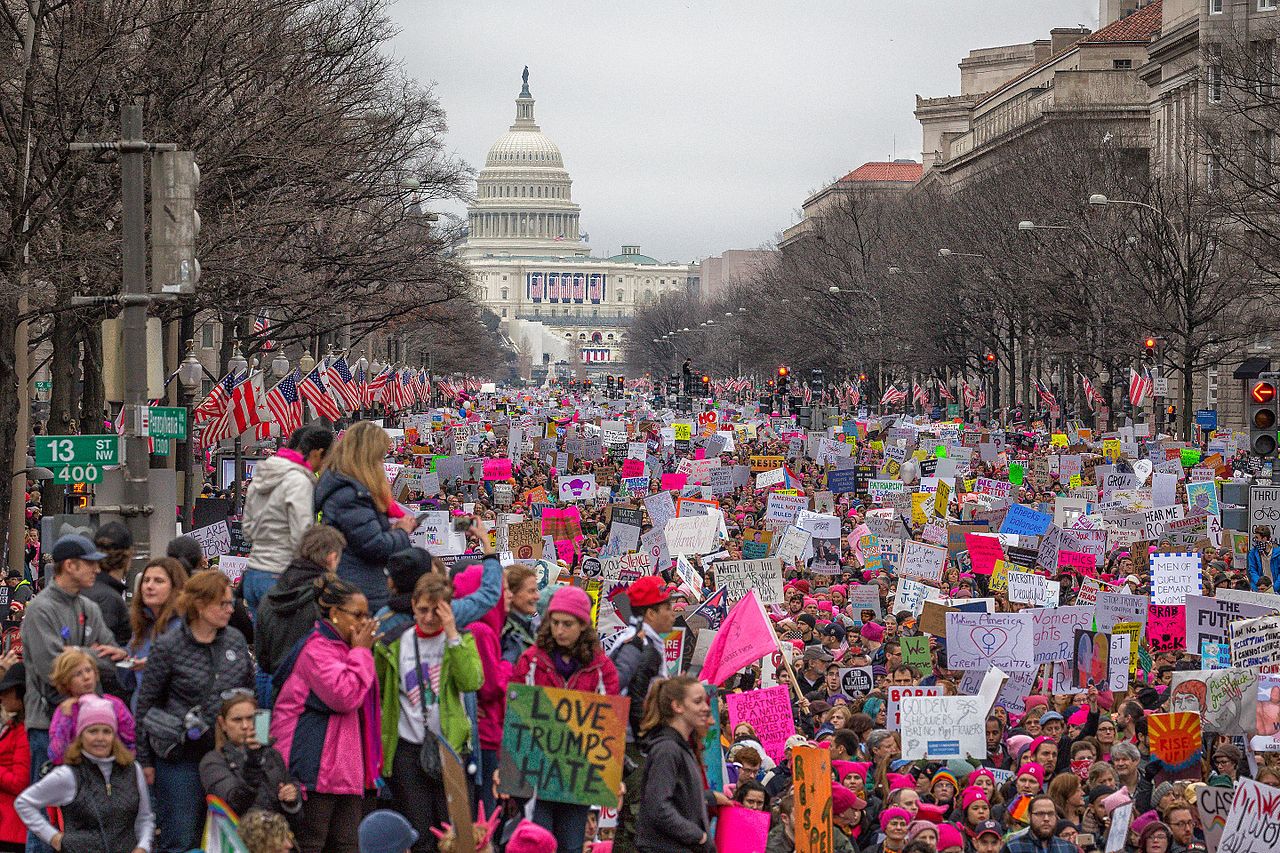
-
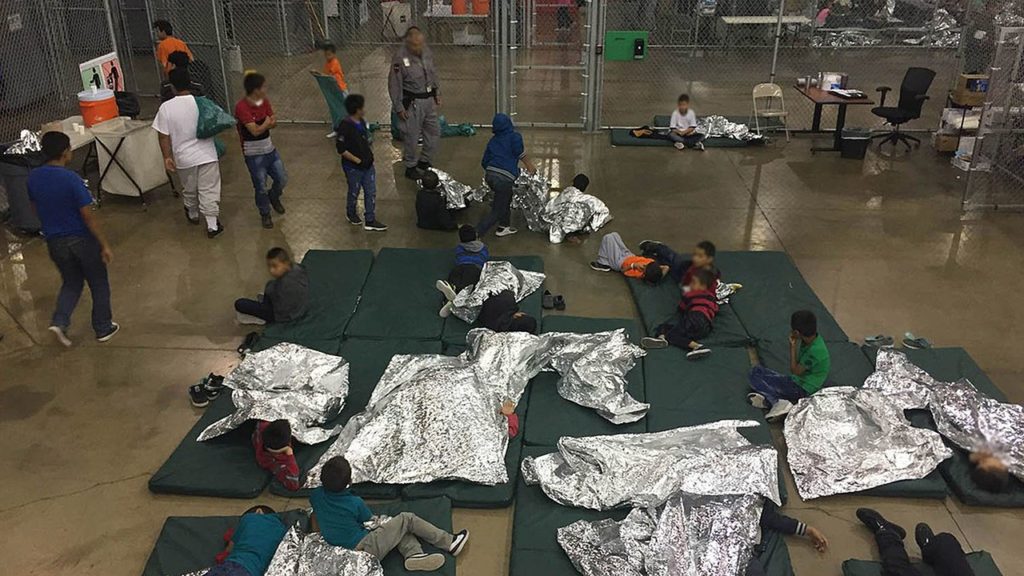
The Trump Administration’s Family Separation Policy at the US-Mexican border was presented to the public as a zero tolerance approach intended to deter illegal immigration. Under the policy, federal authorities separated children from the parents or guardians with whom they had entered the country. The adults were prosecuted and held in federal jails, and the children placed under the supervision of the US Department of Health and Human Services. The policy did not include measures to reunite the families that it had separated. In January 2020, the Southern Poverty Law Center reported that the official government number of children separated from their parents or guardians was 4,368, though it is likely that the accurate number is much higher.
For a broader history of this policy see WAM Scholar-In-Residence Dr. Laura Briggs’s latest book: Taking Children: A History of American Terror
Photo: by US Custom and Border Protection of detention facility in McAllen, Texas 2018